


Screen printing or DTF? It has become the most common question before starting a textile personalisation project. Both are heat-applied marking techniques with excellent results, but they don’t meet the same needs.
At PrintMyTransfer, a French transfer manufacturer, we produce both every day. Here is a clear comparison of finish, colours, materials, durability and volumes to choose the solution best suited to your project.
See also: DTF transfer: everything you need to know
What is a screen printing transfer?
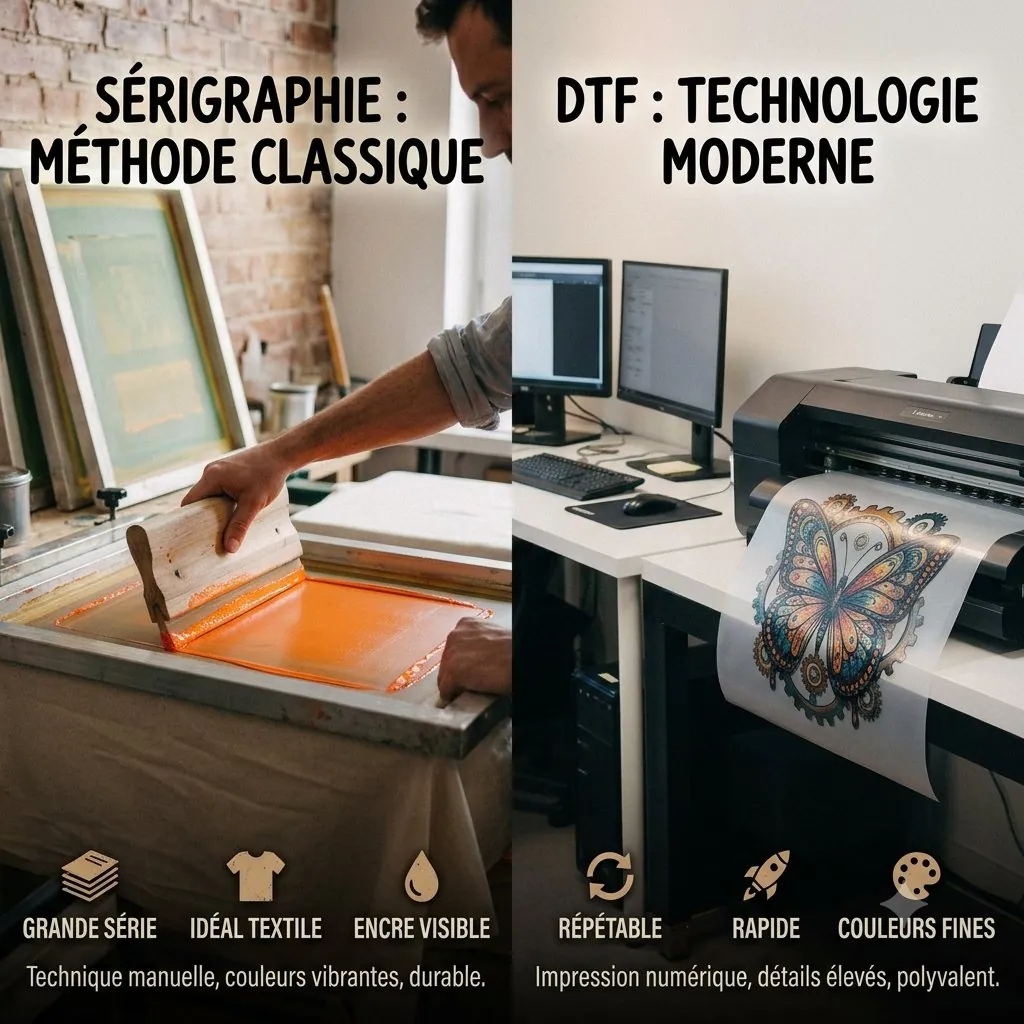
The screen printing transfer consists of depositing screen printing inks onto an intermediate transfer paper, then applying them to the fabric using a heat press. It is a benchmark technique, renowned for its durability over time.
Key strengths
- Exceptional wash resistance: the finish stays intact wash after wash, even with intensive use.
- Great detail precision, from single colour to full CMYK, ideal for technical visuals and logos.
- No cutting or weeding: only the ink is transferred, the outlines are clean and the transfer is delivered ready to press.
- Application suited to delicate materials: windbreakers, umbrellas, luggage, on light and dark textiles alike.
- Cost-effective on medium and large runs, especially for repeated multicolour visuals.
Limitations
- Faded gradients are limited: they require a solid colour area with a supporting white, and are only fully rendered on white fabric.
- The final result depends on the quality of the file supplied at the outset.
In short, the screen printing transfer is the best choice when durability and volume come first, on visuals with well-defined colours.
What is DTF (Direct-To-Film)?
DTF is a digital technology: the visual is printed in full colour onto a transparent film, then transferred to the fabric with a heat press. It is the fast, versatile solution for small and medium runs.
Key strengths
- Photo-quality full-colour printing, with gradients and fine detail down to 0.3 mm.
- No outline or overhang: the visual blends perfectly into the fabric.
- Great versatility: applies to most standard textiles, light or dark.
- No minimum number of colours: a highly colourful visual costs no more than a single-colour one.
- Quick and easy application in seconds with a heat press.
Limitations
- For very intensive washing and long service life on large runs, the screen printing transfer keeps the advantage.
- As with any digital printing, the final result depends on the quality of the visual supplied at the outset.
In short, DTF is ideal for photographic, colourful or detailed visuals, in small and medium runs, with an excellent flexibility/speed ratio.
Comparison table: screen printing vs DTF
| Criterion | Screen printing transfer | DTF |
|---|---|---|
| Principle | Screen printing inks on transfer paper, heat-applied | Digital full-colour printing on film, heat-applied |
| Finish and precision | Clean solid areas, from single colour to full CMYK | Photo quality, gradients, 0.3 mm detail, no outline |
| Colours and gradients | Limited gradients (solid area + supporting white) | Native gradients and very colourful visuals, at no extra cost |
| Materials | Light/dark textiles + delicate materials (windbreakers, luggage…) | Most textiles, light or dark |
| Durability | Excellent, the benchmark for wash resistance over time | Very good, flexible application with no overhang |
| Ideal runs | Medium to large runs, cost-effective in multicolour | Small and medium runs |
| Application | Heat press, ready to press, no weeding | Heat press, in a few seconds |
Screen printing or DTF: how to choose?
Choose the screen printing transfer if…
…you produce medium or large runs, want the best possible wash resistance, mark delicate or technical materials, or are looking for the best cost on repeated multicolour visuals.
Choose DTF if…
…your visuals contain photos, gradients or many colours, you work in small or medium runs, and you need speed and versatility with no minimum number of colours.
Unsure about your project? Our advisors will guide you towards the most suitable technique.
Frequently asked questions
What is the main difference between screen printing and DTF?
The screen printing transfer uses screen printing inks applied via a transfer paper: it excels at durability and runs. DTF is digital full-colour printing on film: it excels at photographic visuals, gradients and small runs.
Is DTF more resistant than screen printing?
Both offer very good durability. For very intensive washing and large runs over time, the screen printing transfer remains the benchmark.
Can you print photos and gradients?
Yes, natively with DTF. With screen printing, gradients are possible but limited, and best rendered on white fabric.
Screen printing or DTF for dark textiles?
Both techniques apply equally well to light and dark textiles. The choice therefore mainly comes down to the desired finish and the volume.
Ready to start your marking? Discover our screen printing transfers and our DTF transfers, or contact us for tailored advice.