



DTG or DTF? These two digital textile printing techniques have similar-sounding names and both deliver great photo quality, but they don’t work the same way at all, and they don’t meet the same needs.
At PrintMyTransfer, a French transfer manufacturer, we have made a clear choice: we do not offer DTG, but we produce DTF (and screen printing transfers) every day. Here is an honest comparison (covering how they work, materials, colours, durability and logistics) to understand the differences and see why DTF transfer is, for most professional projects, the most versatile solution.
What is DTG (Direct-To-Garment)?
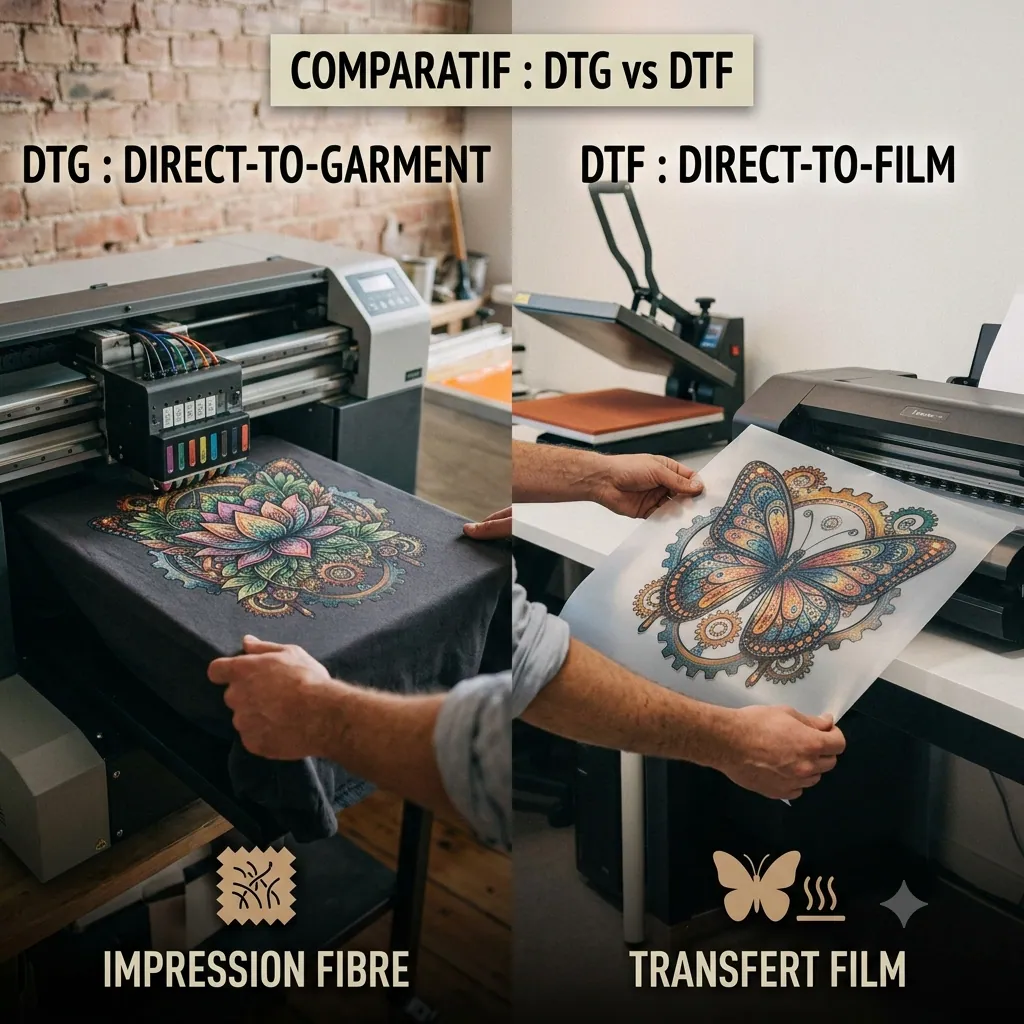
DTG, or direct digital printing, sprays the ink straight onto the garment, a bit like a giant inkjet printer: the droplets are absorbed by the fabric fibres. There is no intermediate carrier; you print on the finished garment itself, usually cotton.
Key strengths
- Photo quality with subtle gradients and highly detailed visuals, with no colour limit.
- A very soft feel, close to the bare fabric, because the ink soaks into the fibre.
- No minimum order: DTG is suited to single pieces and very small runs.
- Ideal for large designs and complex artwork on light cotton.
Limitations
- Restricted to natural fibres: DTG needs a mostly cotton textile, and gives disappointing results on synthetic or technical fabrics.
- Pre-treating the garment is mandatory, and printing on dark textiles requires a more costly white underbase.
- Wash resistance is more fragile: designs may fade slightly after several dozen washes.
- You print on the finished garment: you cannot stock a "ready-to-press" visual, you need the textile on hand at print time.
In short, DTG shines on complex photographic visuals in very small quantities, but only on cotton and with strong constraints around material, pre-treatment and logistics.
What is DTF (Direct-To-Film)?
DTF is also a digital technology, but with one key difference: the visual is printed in full colour onto a transparent film, then transferred to the fabric using a heat press. You get a ready-to-press transfer, independent of the material, that you apply whenever and wherever you want.
Key strengths
- Photo-quality full-colour printing, with gradients and fine detail down to 0.3 mm, which is on a par with DTG in terms of finish.
- Great versatility: applies to most textiles, light or dark, cotton or synthetic, where DTG is limited to cotton.
- No textile pre-treatment, no outline or overhang: the visual blends into the material.
- No minimum number of colours: a highly colourful visual, or one on dark fabric, costs no more.
- A transfer that can be stocked and applied on demand, making it ideal for marking textiles already in stock, awkward areas, or restocking without reprinting.
- Quick and easy application in seconds with a heat press, and good durability over time.
Limitations
- For very large, repeated multicolour runs, the screen printing transfer often remains more cost-effective.
- As with any digital printing, the final result depends on the quality of the file supplied at the outset.
In short, DTF offers the same photographic detail as DTG, but without its material constraints: it is the solution we favour for professional textile personalisation.
Comparison table: DTG vs DTF
| Criterion | DTG printing | DTF transfer |
|---|---|---|
| Principle | Ink sprayed directly onto the garment (inkjet) | Full-colour printing on transparent film, heat-applied |
| Materials | Natural fibres, mainly cotton | Most textiles, light or dark, cotton or synthetic |
| Finish and colours | Photo quality, gradients, no minimum number of colours | Photo quality, gradients, 0.3 mm detail, no minimum number of colours |
| Preparation | Pre-treatment mandatory, white underbase on dark | No pre-treatment, direct application |
| Durability | Decent, may fade after many washes | Very good, flexible application with no overhang |
| Logistics | Printing on the finished garment, no stock of visuals | Ready-to-press transfer, stockable, applied on demand |
| Available at PrintMyTransfer | Not offered | Yes, textile DTF and UV DTF |
DTG or DTF: how to choose?
DTG can work if…
…you print single pieces on light 100% cotton T-shirts, you already have the finished garments to hand, and the cotton-only and pre-treatment constraints are not a problem for you.
Choose DTF if…
…you want photographic detail without DTG’s limits: marking light and dark alike, cotton and synthetic, with no pre-treatment, using a ready-to-press transfer that you stock and apply on demand. It is the best balance of finish, versatility and speed, and it is what we produce.
Unsure about your project? Our advisors will guide you towards the transfer technique best suited to your needs.
Frequently asked questions
What is the difference between DTG and DTF?
DTG (Direct-To-Garment) prints the ink directly into the garment fibres, like an inkjet printer: you therefore need the finished, mostly cotton textile. DTF (Direct-To-Film) prints the visual onto a transparent film, then transfers it with heat: it is a ready-to-press transfer, stockable, that applies to almost any textile, light or dark.
Is DTF more durable than DTG?
DTF offers very good wash resistance across a wide range of textiles. DTG, on the other hand, tends to fade slightly after several washes and depends heavily on a cotton material and correct pre-treatment. For reliable durability on varied materials, DTF is the more versatile option.
Does DTG work on dark and synthetic textiles?
DTG is optimised for natural fibres, mainly cotton, and becomes costly and less reliable on dark textiles (white underbase, pre-treatment) or synthetics. DTF applies equally well to light and dark textiles and to most materials, with no extra cost linked to colours.
Does PrintMyTransfer offer DTG?
No. At PrintMyTransfer, we have chosen DTF transfer and screen printing transfer, which offer more versatility, application on demand and logistics suited to professionals. We do not offer DTG, but we are happy to help you choose the transfer technique best suited to your project.
Ready to start your textile marking? Discover our DTF transfers, compare screen printing and DTF too, or contact us for tailored advice.