Screen-printed transfers, DTF and UV DTF stickers for your professional textiles and objects




What is offset printing?
Known for its flexibility and adaptability, offset printing is the most widespread direct printing technique today. Highly appreciated by professionals, this technique, based on the principle of water-ink repulsion, enables printing...
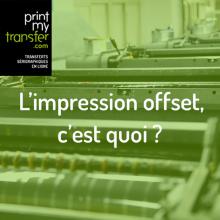
Offset printing: how does it work?
Technically, how does offset printing work? Offset printing consists of two main families: the wet process (conventional) and the dry process (waterless).
Conventional offset printing: the wet process
Historically, the process has its origins in lithography. The printing process is based on the principle of water-ink repulsion; in other words, since water and grease do not mix, an emulsion is created between the dampening solution and the greasy ink.
Here is a step-by-step overview of how offset printing works:
- Step 1 – Plate preparation: The print file is engraved onto a metal plate using a Computer-to-Plate device (a computer peripheral that directly creates the plates used for the presses).
- Step 2 – Inserting the metal plate into the printing process: The metal plate is inserted into the first machine in the offset printing process. The offset printing process consists of several machines: one printing machine per colour, traditionally 4 (Cyan, Magenta, Yellow, Black).
- Step 3 – Positioning the paper: The paper is then fed into the machine, which checks using air jets that the sheets are not stuck together and that only one sheet is fed at a time.
Once everything is ready, the machines are switched on and the printing process begins.
- Step 4 – Dampening: The plate passes through the first machine, which is mounted on a rotating cylinder. The plate then comes into contact with dampening rollers that moisten the entire plate.
- Step 5 – Inking: Inking rollers then apply ink and distribute it across the plate.
- Step 6 – Image transfer: This is where the specific feature of the process lies: the blanket. This penultimate rubber cylinder allows the inked image to be transferred in reverse.
- Step 7 – Printing: The paper passes between the blanket and the impression cylinder to gradually transfer the reversed image onto the paper.
The plate and paper then continue through the next press, corresponding to the next colour. Once all presses have been passed through, drying takes place! The paper is dried with hot air and stacked awaiting dispatch.
Waterless offset printing: the dry process
Waterless offset printing follows the same principles as conventional offset printing, with the one major difference that it uses no water! There is no dampening system; water is replaced by silicone, which prevents ink from adhering to the plate.
Offset printing: for which uses?
As mentioned above, offset printing is used for a wide range of products, including newspapers, books, catalogues, banknotes, screen-printed transfers, etc. More broadly, it can process different types of materials: cardboard, paper, plastic, metal, etc.
At PrintMyTransfer, we use it to print our screen-printed transfers!
Offset printing: advantages
Here are the main advantages of offset printing:
- The process starts up quickly
- Adaptability & flexibility: in terms of product production and quantities
- Costs are controlled and low compared to other printing processes
- Drying is fast
- Ink is well stabilised, the print is photo quality!
It is the ideal printing process for four-colour printing.
Offset printing: disadvantages
- The cost of consumables: inks and plates must be replaced frequently.
- Maintenance: regular and significant checks on the machines are needed to avoid misalignment and errors.
- Possible paper waste during make-ready