Screen-printed transfers, DTF and UV DTF stickers for your professional textiles and objects



What is digital printing?
Digital printing is a modern printing process that allows files from computers to be printed directly onto paper. Known and appreciated for its speed and low cost, digital printing is today considered the main alternative to offset printing.
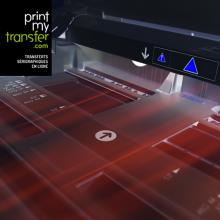
Discover digital printing for textiles
Digital printing: how does it work?
On the technical side, how does digital printing work?
There are two main types of digital printing: inkjet printing and laser printing.
Inkjet digital printing
Inkjet printing involves sending a continuous jet of ink onto paper, fed by liquid ink cartridges. Depending on the print file, an electric charge guides the ink through multiple deflections, making it possible to produce the desired image.
Inkjet digital printing can now achieve clean results that tend to approach the quality offered by the offset process today.
Laser digital printing
Laser digital printing is an electrostatic system, operating with powders, which involves creating the image on a mechanical drum. Technically, the drum is coated with a semi-conductive substance that allows the powder to adhere only to the illuminated areas of the drum, thus reproducing the desired image in a single pass.
The quality of this printing process is also very close to that provided by offset.
Digital printing: what are the uses?
Digital printing is used mainly for on-demand prints, personalised prints and small quantities.
This process is particularly used to create communication materials. These include:
- Logos
- Advertising images
- Packaging
- Packagings
- Books
- Etc.
Digital printing for textiles?
Digital printing can also be used to print on textiles. Known as "direct-to-garment printing (DTG)", this method uses digital technology to print motifs directly onto fabric, with no intermediate step. For more details on direct digital printing, click here.
Digital printing: the advantages
Digital printing is increasingly appreciated among printers. This is notably due to the advantages it offers:
- Economy: printing costs are low
- Speed: production lead times are very short
- Adaptability: production of small personalised runs
Digital printing: the disadvantages
Even though digital printing has become widely accessible and increasingly sophisticated, it still comes with a few significant disadvantages:
- The process is not suited to large print runs and mass production
- The choice of formats and paper types is limited
- Consumables are numerous and difficult to recycle